



The Arrival of the Railroad in Chagrin Falls: Transforming a Growing Community
In the late 19th century, railroads were reshaping towns and industries across America. By 1877, more than 79,000 miles of railroad track crisscrossed the United States, connecting communities to markets, resources, and opportunities. Yet despite its thriving industries and growing population, Chagrin Falls, Ohio, remained without a railroad connection, creating significant challenges for local businesses and residents.
Chagrin Falls Before the Railroad
Before rail service reached the village, residents and business owners were forced to travel to nearby Solon to access railroad transportation for both passenger travel and freight shipping. This lack of direct rail access placed Chagrin Falls at a competitive disadvantage.
Local manufacturers, mills, and factories faced higher transportation costs and limited access to raw materials. As neighboring communities benefited from modern transportation networks, many Chagrin Falls residents became increasingly frustrated and began advocating for a railroad connection of their own.
Early Railroad Efforts and Setbacks
Chagrin Falls first tried to acquire a railroad in 1844. The town paid an engineer to survey a line from Cleveland to Chagrin. They also raised stock, valued at $24,000. However, the venture did not go very far and all investors lost their investments. The next attempt was in 1847. The town worked with the town of Warren to get a Pittsburgh to Cleveland line. It was planned to follow the same route as the existing stagecoach line from Pittsburgh to Cleveland. The town was able to get a charter for the line and raised more money for the venture. However, the railroad decided to go through Solon due to flatter terrain. A spur was promised to Chagrin Falls but never delivered. In 1852, Chagrin Falls once again tried to get a railroad line. This time they tried to get on the Painesville to Hudson line. They formed the Painesville and Hudson railroad and raised $1 million in capital, created a board and sold stock ($200,000 in Chagrin alone). The railroad began in Painesville and ran to Chardon but was never finished. The Board was taken to court but only the lawyers made any money. The investors lost all their money – again. In 1872, village residents voted in favor of bringing a railroad to Chagrin Falls. Following the vote, the Cleveland and Mahoning Valley Railroad agreed to construct a rail line between Solon and Chagrin Falls.
However, the project was derailed by the economic turmoil of the 1870s. The Panic of 1873, followed by a series of economic depressions, bankruptcies, railroad mergers, labor strikes, and riots, halted construction plans and delayed the community’s hopes for rail service.
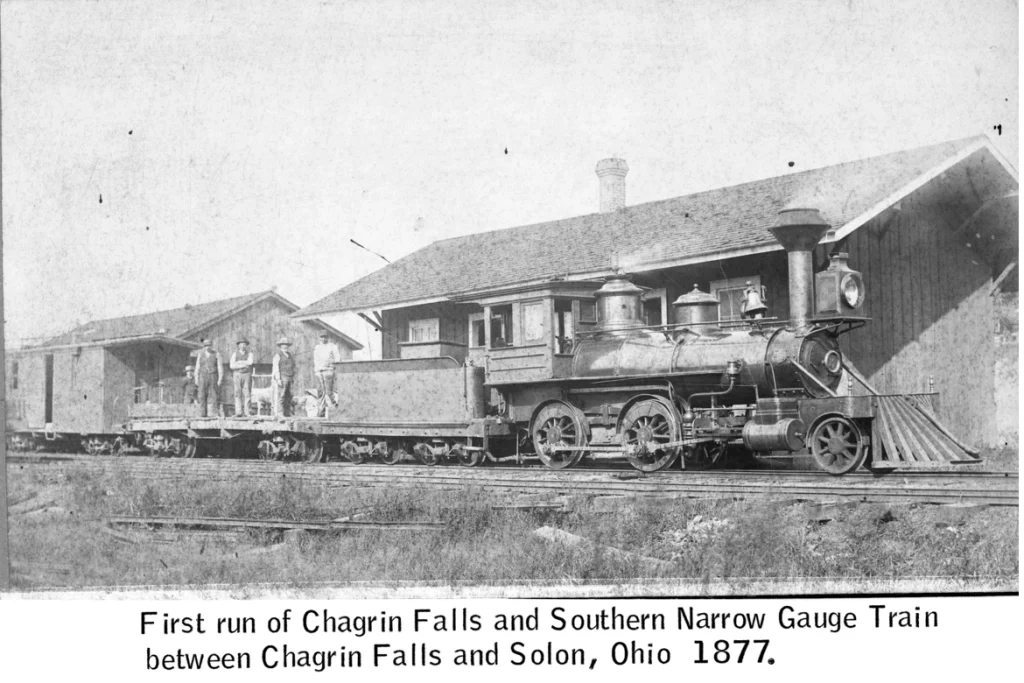
Construction of the First Railroad
A few years later, the Painesville, Canton, and Bridgeport Narrow Gauge Railroad (PC&B) took on the challenge of building the line.
Construction was finally completed on December 15, 1877, when prominent Chagrin Falls citizens William “Boss” Hutchings and Washington Gates ceremonially drove the final spike into place.
The new railroad route connected Solon and Chagrin Falls, passing near the site of the current post office and terminating at a station located just east of the Philomethian Street School. Today, the location is occupied by the Bell Tower condominiums.
The station’s location was ideal, providing convenient access to the numerous factories, mills, and businesses operating along the Chagrin River.
Financial Troubles and Local Ownership
Despite completing the railroad, the PC&B Railroad struggled financially and was unable to repay its construction bonds. In 1880, local Chagrin Falls residents repossessed the railroad and reorganized it under a new name: the Chagrin Falls and Southern Railroad (CF&S).
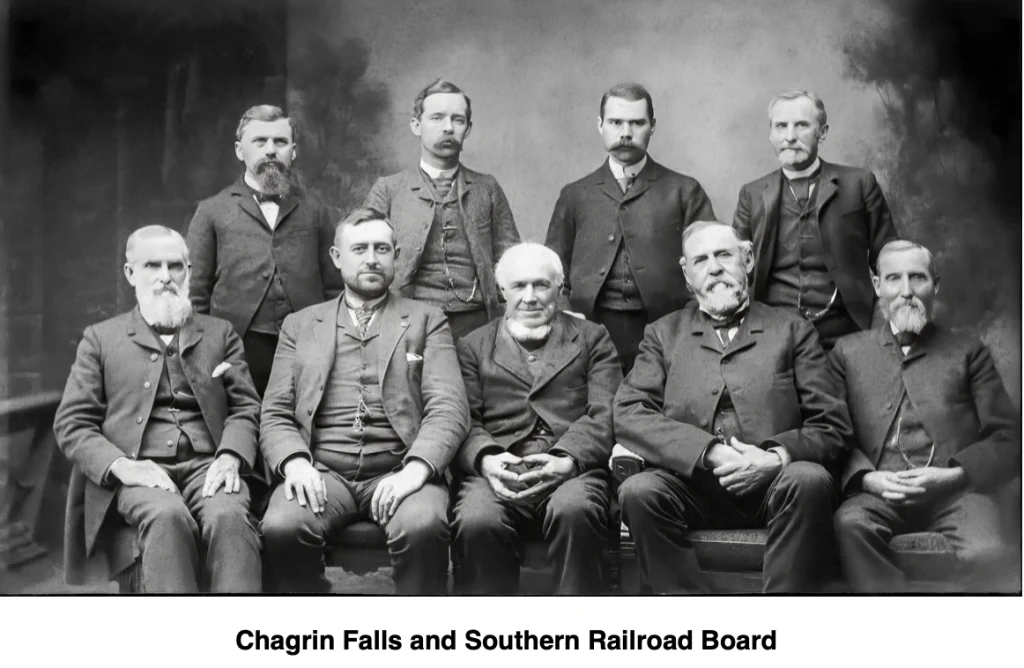
Front row L to R: John Bullard, George March, William Hutchings, Albon Gardner, Joseph Stoneman Top row L to R: Orrin Frazer, JW Williams, Fitch Adams, Alfred Adams
While the railroad provided valuable transportation service, it faced a significant limitation. The narrow-gauge tracks restricted freight capacity and were incompatible with most other railroads operating throughout Ohio and the nation.
Expansion and Conversion to Standard Gauge
A major improvement came in 1890 when the Chagrin Falls and Southern Railroad merged with several regional railroads to form the Cleveland, Canton, and Southern Railroad.
The new company converted the line to standard gauge, allowing trains to operate seamlessly with other railroad systems. This upgrade eliminated the need for passengers to change trains in Solon when traveling to Cleveland and enabled Chagrin Falls manufacturers to ship products directly to customers across a wider market.
The conversion significantly strengthened the village’s economic position and enhanced its connection to regional commerce.
The Rise of Electric Railways
The development of electric motors and dynamos in the late 1880s ushered in a new era of transportation. Electric interurban railways began appearing throughout Ohio, offering faster, cleaner, and more efficient passenger service.
In 1897, an electric rail line connecting Cleveland and Chagrin Falls began operation. The new service quickly became a popular alternative to the steam railroad, providing more convenient passenger transportation.
Competition from the electric railway was intense, and by 1898 the steam railroad had lost its passenger business.
The End of Steam Rail Service
Although passenger service disappeared, the steam railroad continued to play an important role in the local economy by hauling freight for nearly another century.
Freight operations remained active until 1983, supporting businesses and industries throughout the region. After more than 100 years of service to Chagrin Falls, the railroad’s tracks were officially abandoned in 1989.
Railroad Legacy in Chagrin Falls
The arrival of the railroad marked a turning point in the history of Chagrin Falls. It connected the village to regional and national markets, fueled industrial growth along the Chagrin River, and helped transform the community into a thriving commercial center.
Though the trains are gone, the railroad’s impact remains visible in the development patterns, historic sites, and industrial heritage that continue to shape Chagrin Falls today.