
Early Life of E.B. Hill
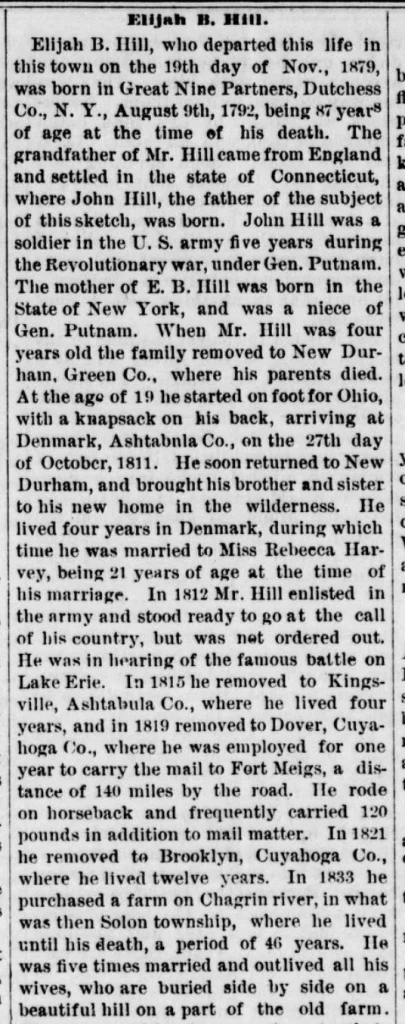
Elijah B. Hill, commonly known as E. B. Hill, was born on August 9, 1792, in Great Nine Partners, Dutchess County, New York. He died on November 19, 1879, at the age of 87 after living a remarkable life as an early Ohio pioneer and settler.
Hill came from a family with deep colonial American roots. His grandfather emigrated from England and settled in Connecticut, where his father, John Hill, was born. John Hill later served in the United States Revolutionary Army during the American Revolutionary War under General Israel Putnam. E. B. Hill’s mother was also related to General Putnam, being his niece. Years later, the Hill family relocated to New Durham in Greene County, New York, where both of Elijah’s parents eventually died.
Journey to Ohio and Settlement in Ashtabula County
At just 19 years old, E. B. Hill set out for Ohio on foot carrying only a knapsack. He arrived in Denmark Township, Ashtabula County, on October 27, 1811, during a time when much of northeastern Ohio remained wilderness.
Soon after establishing himself, he brought his brother and sister to join him in Ohio. During his four years in Denmark Township, he married Rebecca Harvey, who was 21 years old at the time.
Service in the War of 1812
While living in Ashtabula County, Hill enlisted in the United States Army during the War of 1812. Like many early settlers of the Western Reserve, he balanced military service with the hardships of frontier life.
Move to Kingsville and Dover Township
In 1815, Hill moved to Kingsville in Ashtabula County, where he lived for four years before relocating again in 1819 to Dover Township in Cuyahoga County, Ohio.
During this period, he worked as a mail carrier traveling between Dover and Fort Meigs. The route covered approximately 140 miles, which he traversed on horseback while often carrying 120 pounds in addition to the mail itself. The work demanded extraordinary physical endurance and resilience.
Life in Brooklyn and Settlement Along the Chagrin River
In 1821, E. B. Hill moved to Brooklyn Township in Cuyahoga County, where he remained for 12 years.
Then, in 1833, he purchased a farm along the Chagrin River in what was then Solon Township. This property became his permanent home for the remainder of his life. The farm later gained historical importance when the Chagrin Falls & Solon Railroad passed directly through his land.
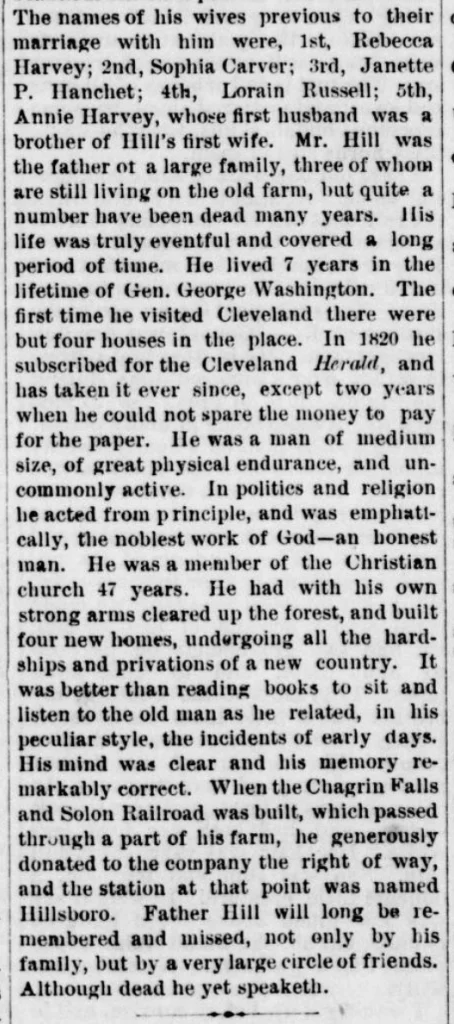
Hill generously donated the railroad right-of-way to the company, helping support transportation and development in the region. The nearby railroad station became known as Hills Boro, preserving the Hill family name in local history.
Pioneer Life in the Western Reserve
As one of the early settlers of Ohio’s Western Reserve, E. B. Hill experienced the difficult realities of frontier life firsthand. Described as a medium-sized man with exceptional physical endurance, he personally cleared forests and built four homes with his own labor.
Like many pioneers of northeastern Ohio, Hill endured the hardships and privations common to settlers transforming wilderness into productive farmland and thriving communities.
Community Involvement and Legacy
E. B. Hill remained active in the local community throughout his life and was known for his public service and civic involvement in the Chagrin Falls area.
His life story reflects the determination, endurance, and community spirit of the early settlers who helped shape Cuyahoga County and the Chagrin Valley during the 19th century.
Elijah B. Hill’s obituary from The Exponent, 1879