
Pioneering Builder and Civic Leader in Chagrin Falls
Early Life in Devonshire, England
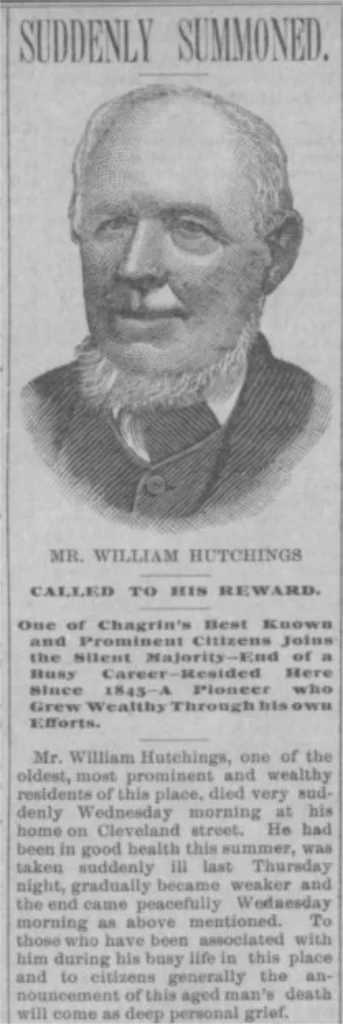
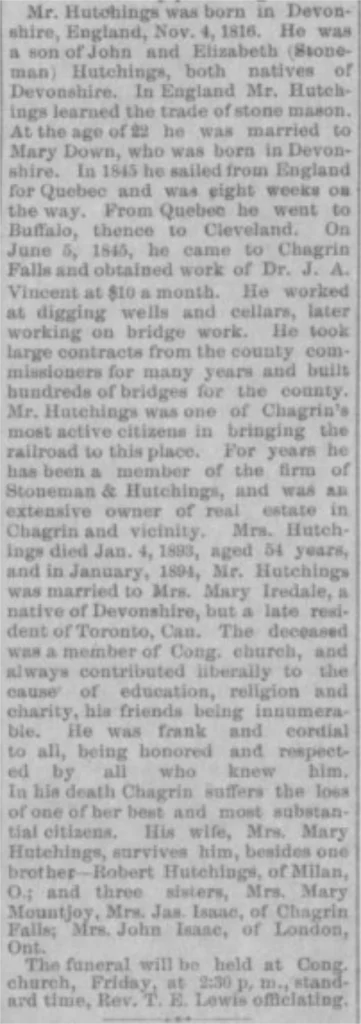
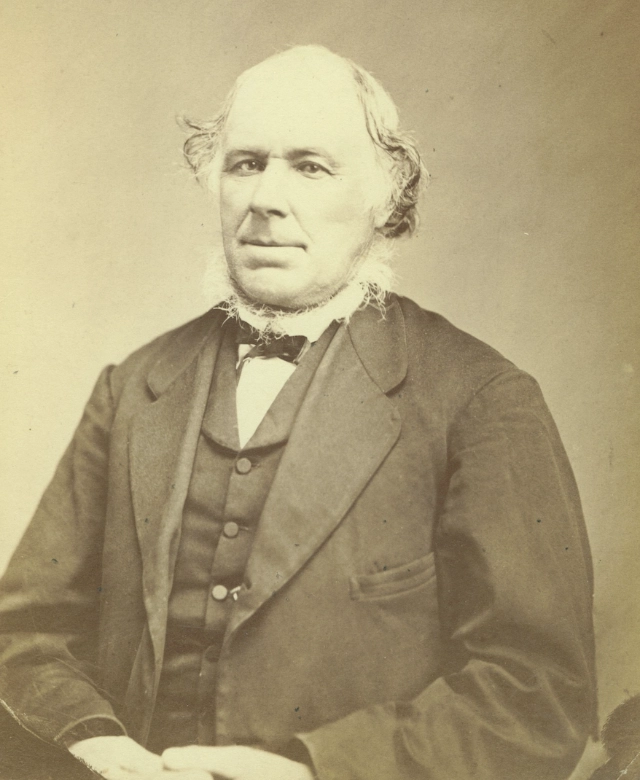
William Hutchings was born in the parish of Langtree in Devonshire, England, on November 4, 1816, to John and Elizabeth (Stoneman) Hutchings. At the age of 22, he married Mary Down and the 1841 census of Langtree lists his age (24), his wife (Mary) and his occupation (“ag lab” – agricultural laborer). However, very nearby, there was a quarry where he learned the trade of a stonemason, laying the foundation for his lifelong career in construction.
Their Journey to North America and early life in Chagrin Falls
In 1845, he and his wife sailed from Plymouth, England, for Quebec. They were six weeks on the sea and another two weeks on a river and canal ship. From Quebec they went to Buffalo and then to Cleveland and finally to Orange Township, where his uncle, John Stoneman, was a successful farmer.
After a few days on his uncle’s farm, he went to Chagrin Falls and became employed by Dr. J. A. Vincent at $10 a month. From Pioneer Women of Chagrin, published in The Republican in 1897: “When they had saved $40, one acre of land was purchased. For some reason a clear title could not be secured unless they bought another acre adjoining, at $35. After much worry they thought of the possibility of borrowing the required sum of a friend 8 miles west of Cleveland. So Mrs. Hutchings set out on foot and alone. Returning in three days with the money, they then secured the title to the land.”
Career as a Builder and Bridge Constructor
The next season, he dug wells and cellars and the next year, he worked on bridges. His workmanship was so good that word spread and soon he was offered large contracts from the county commissioners. He also built many schoolhouses, churches and business blocks in Chagrin Falls and neighboring communities. Most of the early brick houses in Chagrin Falls were built by Hutchings as he had a large brick-yard, extensively selling brick in the area. He also helped many of his fellow Devonshire countrymen to relocate here, housing and employing them for a time.
His most notable work, still operational today, is the Main Street Bridge in Chagrin Falls, constructed in 1858.
Championing the Railroad in Chagrin Falls
Hutchings played a pivotal role in bringing the railroad to Chagrin Falls and served as one of its directors, shaping the village’s growth and connectivity.
Business Ventures: Stoneman and Hutchings Hardware
In 1871, Hutchings began as a silent partner in the firm E. Whitlock and Company, the hardware store on North Main Street. With the unexpected death of Elias Whitlock at the age of 32 in 1875. The company was dissolved and reformed as Stoneman and Hutchings Hardware. This partnership continued successfully until William Hutchings’ death in 1894.
Real Estate and Architectural Legacy
An extensive owner of real estate, Hutchings constructed many notable buildings in Chagrin Falls. Key structures that still stand today include:
- The Federated Church on Bell Street
- 3–11 North Franklin Street (Park Block)
Personal Life and Family
William Hutchings and his first wife, Mary Down were wed in Devonshire, and were never blessed with any children. She passed away in Chagrin Falls in 1893 at the age of 75. One year later, he married Mrs. Mary (Hardwell) Iredale, a widow who also a native of Devonshire, England who had been living in Canada. Less than a year after they were wed, William Hutchings died, age 77.
Probate battle and his widow
His sizable estate was valued well over $70,000 (roughly $2.5+ million in 2026 dollars). The will was contested by his siblings and a long, drawn out probate process ensued, going through the circuit court to the Ohio Supreme Court and back down to the probate court. The legatees lobbed accusations that his widow (whom he had been married to for less than a year) had a living husband in London, Ontario at the time she married Hutchings. Investigators were hired to produce this husband who was still very much alive. However, it turned out that he, in fact, had a wife when he married, rendering their marriage null and void. Another legal tussle was between Joseph J. Davis, the executor of the estate and the widow. Mr. Davis started as a clerk in the hardware store and rose to general manager – and also handled all of Hutching’s financial dealings as “Boss” Hutchings never learned to write (and it appears that the widow, was also was illiterate). The widow petitioned the court for a raise in her stipend and people who knew “Boss” Hutchings were sworn in to give testimony regarding his life style and his spending habits. The estate turned out to be very profitable for the lawyers and the executor, Joseph Davis. In 1922, the fight picked up again after Davis died and a new administrator was appointed. At that point, it was his nieces and nephews who waged the battle as all his siblings (originally named in the will) were deceased.
Chagrin Falls Exponent 1894