



Expanding the Williams Foundry from Chagrin Falls to Ravenna
Early Life in Chagrin Falls
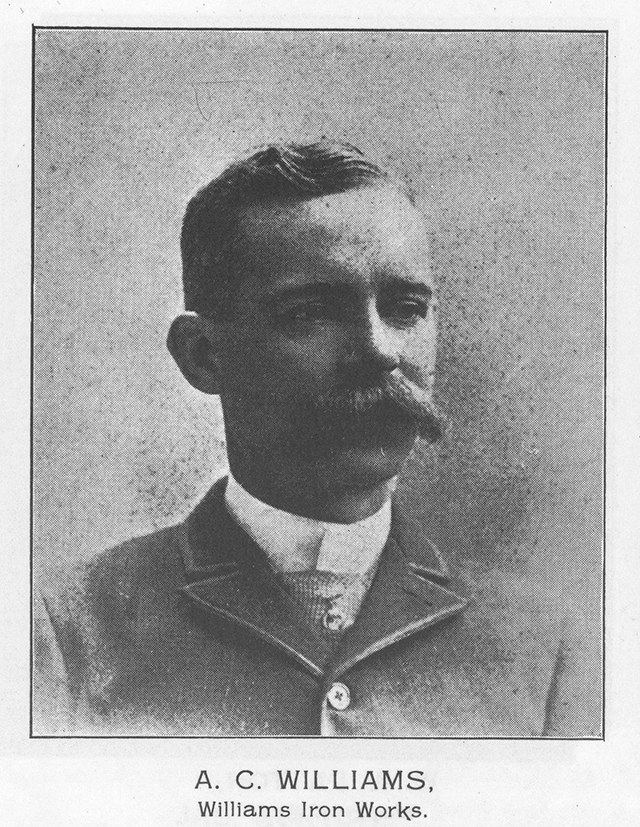
Adam Clark Williams was born in 1826 in Chagrin Falls to John Wesley and Fanny Williams.
AC Williams Joins the Family Business
In 1865, he joined the family foundry business in Chagrin Falls on a full-time basis. The son of industrial pioneer John Wesley Williams, Adam quickly became an important part of the company’s growth and future success.
In 1872, he became a partner in the business, and the company was renamed J.W. Williams & Son. Under the combined leadership of father and son, the foundry continued to expand its manufacturing operations and strengthen its reputation throughout Ohio and beyond.
Taking Ownership of the Williams Foundry
Following the death of his father in 1886, Adam Clark Williams purchased the business and assumed full control of the company. At the time, the foundry employed five molders and a total workforce of approximately fifteen employees.
Seeking to diversify the company’s product line, Williams introduced the manufacture of cast-iron sad irons fitted with wooden handles. These household irons became an important addition to the foundry’s growing range of products.
The Chagrin Falls Railroad and Economic Growth
Adam Clark Williams was also among ten prominent Chagrin Falls citizens who helped establish a narrow-gauge railroad serving the community. The railroad provided vital transportation links for local businesses and manufacturers, making it easier to move raw materials and finished goods.
The new transportation network significantly increased commercial activity in Chagrin Falls and contributed to the continued growth of the Williams foundry.
The Devastating Fire of 1889
In the fall of 1889, Adam Clark Williams was returning home from a business trip to Detroit when he missed a railroad connection in Cleveland and was forced to stay overnight.
While attending a performance at Cleveland’s Park Theatre, an announcement was made from the stage asking Williams to report to the box office immediately. There he learned the devastating news that his foundry in Chagrin Falls was on fire and that there was little hope of saving it.
When Williams arrived home the following morning, he found the plant completely destroyed.
Community Support Helps Rebuild the Foundry
The loss came at a difficult time. Williams was still struggling from the effects of a financial depression and was heavily in debt. Unsure whether rebuilding was even possible, he considered his options.
The citizens of Chagrin Falls, however, rallied behind him. Employees volunteered to work on the new building without pay. The local railroad offered to transport building materials and machinery from Cleveland free of charge. Team owners volunteered their horses and wagons to haul materials from the depot at no cost.
Encouraged by this extraordinary display of community support, Williams decided to rebuild.
On a Sunday morning, just two weeks after the fire, construction began on the new foundry. Approximately one hundred men worked on the project, donating their labor without expectation of payment. The factory was completed, production resumed, and the business once again prospered.
A Second Fire Changes the Company’s Future
Tragedy struck again on Thanksgiving night in 1892 when the rebuilt factory was completely destroyed by another fire.
This second disaster proved to be a turning point. Chagrin Falls lacked adequate fire protection, and transportation limitations continued to present challenges for manufacturing operations. Faced with rebuilding yet again, Williams chose a different path.
He relocated the company to Ravenna, Ohio, where superior railroad connections and improved fire protection offered a more secure environment for industrial growth.
Innovation in Cast Iron Banks
After moving to Ravenna, the company expanded into the manufacture of cast-iron mechanical and still banks. These decorative and collectible banks became some of the company’s most famous products and helped establish a national reputation for quality cast-iron manufacturing.
Many A.C. Williams cast-iron banks are highly sought after by collectors today and remain an important part of American industrial and toy manufacturing history.
The Legacy of A.C. Williams
Adam Clark Williams continued to guide the company through decades of growth and innovation. The business he rebuilt after multiple setbacks evolved into a successful manufacturing enterprise that survived well beyond his lifetime.
He died on June 15, 1932, and was buried in Ravenna, Ohio.
The company he helped build continues today as Lite Metals Company of Ravenna, preserving a direct connection to one of the most important manufacturing families in the history of Chagrin Falls and northeastern Ohio.
Through perseverance, innovation, and determination, Adam Clark Williams transformed a local foundry into a lasting industrial legacy that endured long after the original Williams foundry left Chagrin Falls.