



The Origins of Papermaking in Chagrin Falls
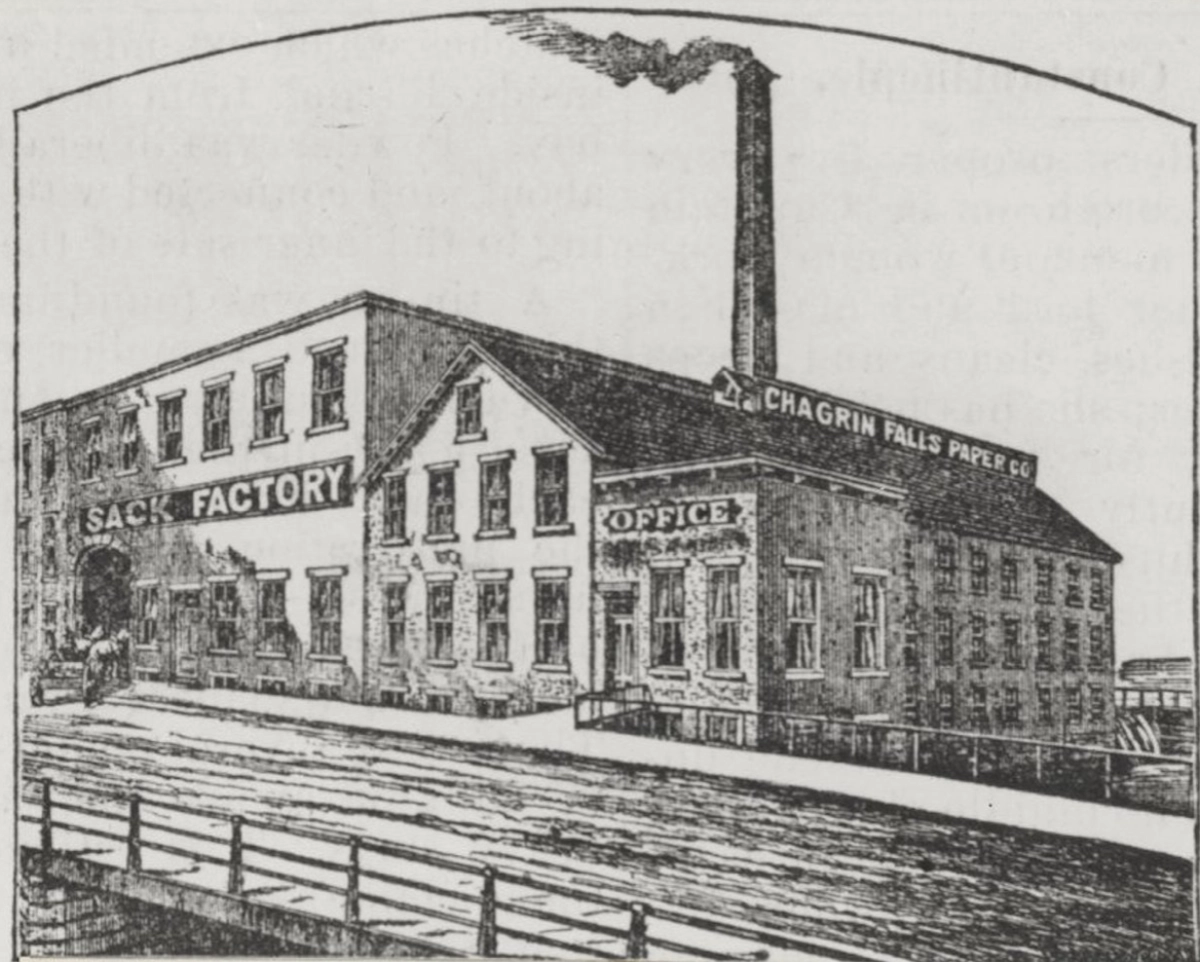
The history of Noah Graves’ Paper Mill is an important chapter in the industrial development of Chagrin Falls, Ohio. Established along the Chagrin River in the mid-1800s, the mill evolved from a small local operation into one of the village’s most significant manufacturing enterprises. Through multiple owners, technological improvements, and changing markets, the paper mill helped shape the economic growth of Chagrin Falls for more than fifty years.
The Beginning of Noah Graves’ Paper Mill
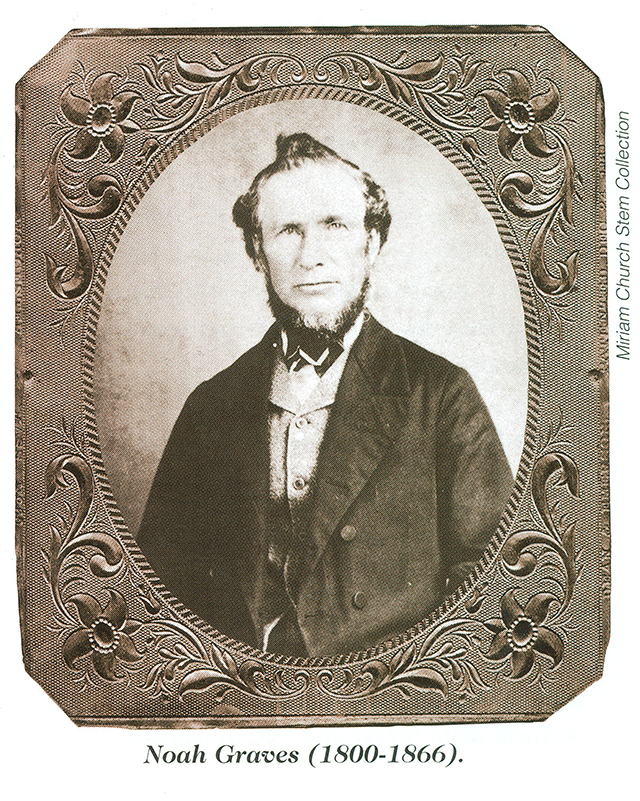
The paper mill was built in the area now known as Riverside Park, adjacent to a sawmill operated by early settler Noah Graves. The land had originally been inherited by Aristarchus Champion from his father, Henry Champion, a member of the Connecticut Land Company.
In 1836, the property was sold to brothers B. H. and H. S. Bosworth, and B. H. Bosworth later acquired his brother’s share. In 1845, Bosworth sold the property to Charles Sears, the same individual who laid out Chagrin Falls’ first cemetery.
Prior to constructing the paper mill, Graves operated a sawmill on the site. Around 1840, he established a paper manufacturing operation next to the sawmill, creating one of the earliest industrial enterprises in Chagrin Falls.
Early Paper Production and Business Partnerships
Graves’ mill initially produced straw paper and rag wrapping paper, products that were in high demand during the nineteenth century. In 1842, Charles Sears joined Graves in business, forming the Graves & Sears Company.
The partnership expanded production beyond wrapping paper to include high-quality writing paper, helping the company reach a broader market. During the mid-1840s, Graves left the business and transferred his interest to Z. Brinsmade, creating the firm of Sears & Brinsmade.
The company continued to diversify its product line, eventually manufacturing tobacco paper in addition to writing and wrapping papers.
Ownership Changes and Economic Challenges
Like many nineteenth-century manufacturing operations, the paper mill experienced frequent ownership changes. The business changed hands several times before ultimately closing in 1850.
The property was then purchased by D. A. Davis, who operated the mill through the difficult years leading up to and during the American Civil War. Although business remained active during the war, economic conditions afterward were challenging. Demand for the mill’s specialty paper products declined, and the company ultimately filed for bankruptcy in 1869.
Formation of the Chagrin Falls Paper Company
Following the bankruptcy, the mill entered a new phase of operation. The property was acquired by a group of local investors that included:
- Irving W. Pope
- Pope D. L. Pope
- John Bleasdale
- Washington Gates
- Elias Whitlock
- N. W. Taylor
Together they organized the Chagrin Falls Paper Company in 1873, creating what would become one of the village’s largest manufacturing enterprises.
Rebuilding and Expansion
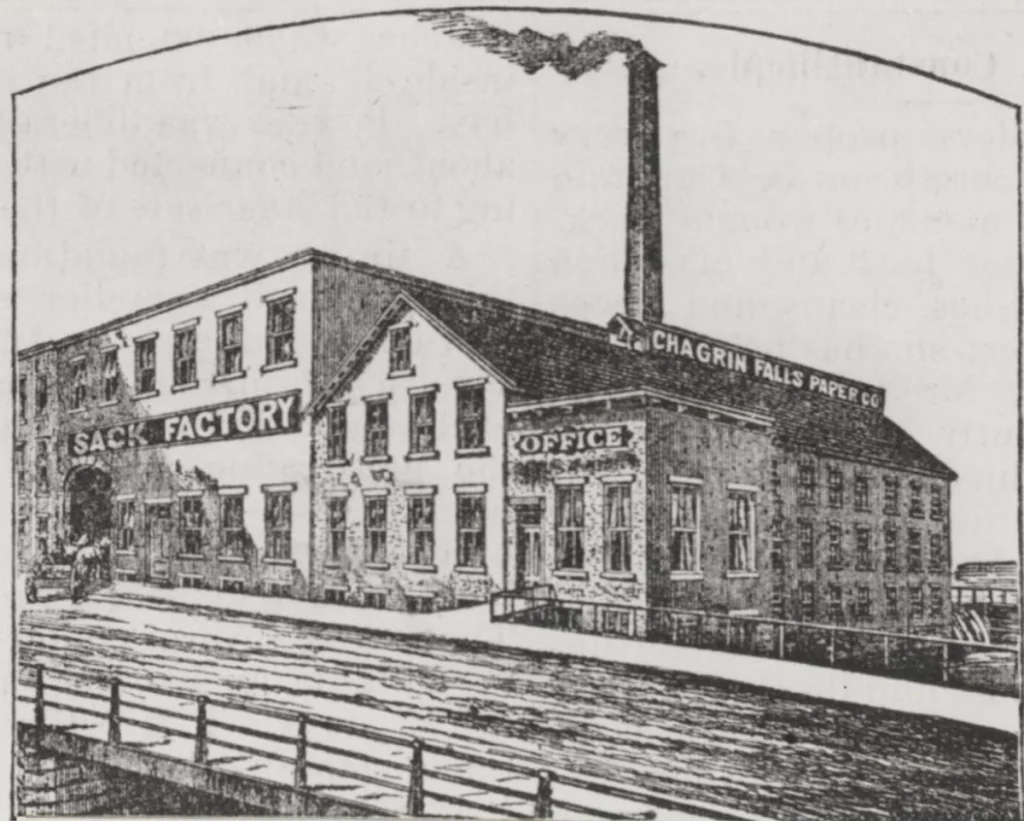
The early years of the Chagrin Falls Paper Company were challenging. Equipment frequently broke down, new boilers were required, and steam engines had to be rebuilt. Despite these setbacks, the company invested heavily in modernization and expansion.
At its peak, the mill employed approximately fifty workers and possessed the capacity to manufacture 15,000 flour sacks per day, making it a major industrial employer in Chagrin Falls.
Products Manufactured at the Mill
During its most successful years, the Chagrin Falls Paper Company produced a variety of specialty paper products, including:
- Manila paper
- Wrapping paper
- Flour sacks
- Window-curtain paper
- Heavy-duty industrial sack paper
One of the company’s most notable products was a specially engineered flour sack paper marketed as “Sacks Half the Weight and Twice the Strength.” The paper was promoted as being nearly impossible to tear and attracted customers far beyond Ohio, including buyers in Australia.
Bankruptcy and Final Sale
Despite its innovations and manufacturing success, the Chagrin Falls Paper Company encountered financial difficulties and filed for bankruptcy in 1888.
Four years later, in 1892, the mill property was sold to Joseph O’Malley, a respected local carpenter known throughout the village for his skilled millwork. The sale marked the end of an important era in the history of papermaking in Chagrin Falls.
The Legacy of Noah Graves’ Paper Mill
The story of Noah Graves’ Paper Mill reflects the entrepreneurial spirit and industrial growth that helped transform Chagrin Falls from a frontier settlement into a thriving manufacturing community. From its beginnings as a small paper operation in the 1840s to the large-scale production of specialty papers and flour sacks, the mill played a significant role in the economic development of the village.
Today, the site serves as a reminder of the many mills and factories that once lined the banks of the Chagrin River, contributing to the rich industrial heritage that remains an important part of Chagrin Falls history.