


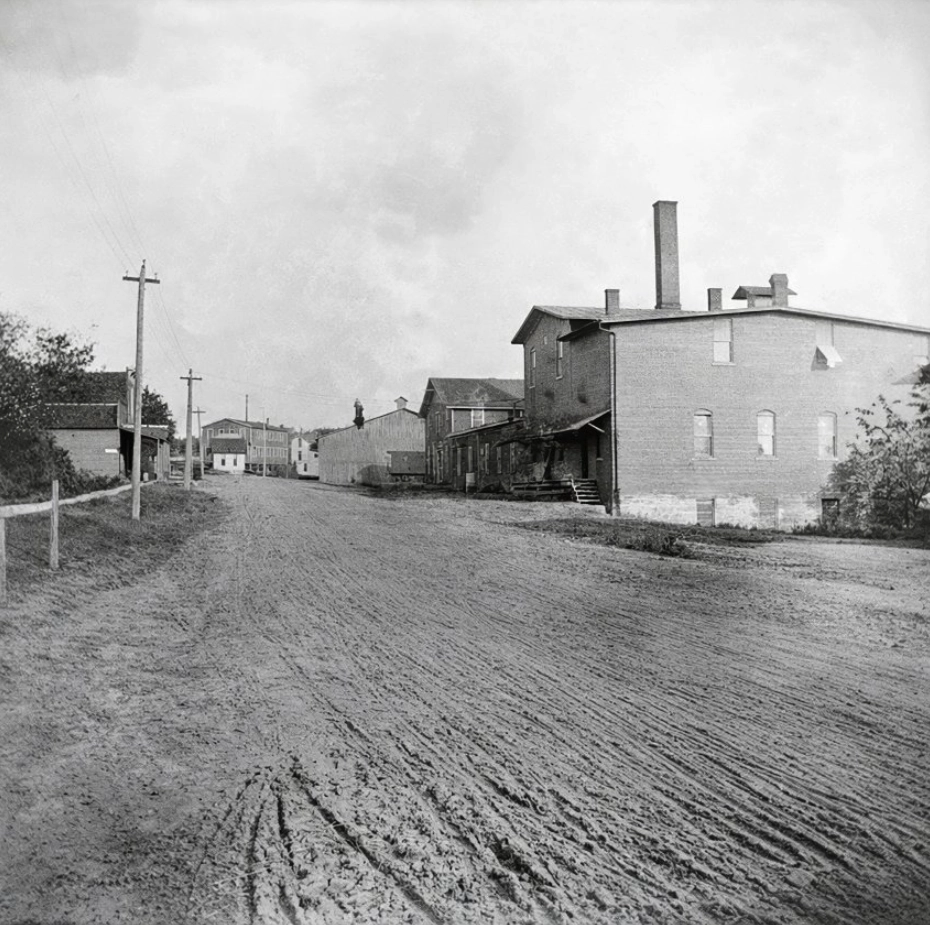
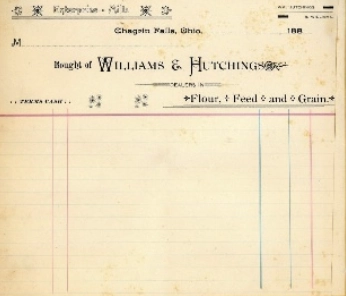
In September 1879, construction began on a new grist mill on Bell Street in Chagrin Falls, built by the firm of Williams & Hutchings, a company formed by Benajah Williams Jr. and William Hutchings. By March 1880, the work was nearing completion, and the Enterprise reporter described the facility as a model mill.
The new mill represented an important investment in the community’s milling industry, incorporating modern machinery and innovative equipment designed to improve the production of flour and other grain products. It was the first mill in Chagrin Falls to be steam powered.
Construction and Design of the Enterprise Milling Company
The main building measured 30 by 50 feet and stood three stories high. An engine and boiler room, measuring 24 by 26 feet, occupied the east side of the building. An additional structure measuring 20 by 50 feet was added to the west side to provide additional space.
The building was constructed by Albert Thomas, while the engine, boiler, shafting, and machinery were supplied and installed by Thomas Sharp & Company of Salem, Ohio.
A Powerful Steam Engine and Modern Machinery
The mill’s steam engine was among its most impressive features. Described as incorporating the latest improvements, the engine had a capacity of 60 horsepower and featured a variable cut-off that allowed it to adjust to the power required for different operations.
The newspaper reported that the engine operated smoothly and almost noiselessly. Smoke from the chimney was first observed on Tuesday, when the machinery was tested with a grist of corn.
The mill’s modern equipment was designed to handle multiple stages of grain processing efficiently, from cleaning wheat to producing different grades of flour and other products.
Inside the Three-Story Grist Mill
The mill’s machinery was arranged throughout its three floors, with each level serving a specific purpose.
The Basement: Driving and Cleaning Equipment
The basement housed the main driving shaft and the first machine used in processing wheat, known as the smutter. This machine cleaned the wheat by removing dust and other particles. The grain then passed through brushes that removed additional material before being elevated to the third floor.
The Second Floor: Grinding and Processing Grain
The second floor contained five runs of millstones in several sizes, including 48-inch, 36-inch, and 30-inch stones. These were used for producing flour, feed, bran, and middlings.
The newspaper also described the process of separating and refining the wheat products. Wheat passed through brushes before reaching the grinding equipment. After grinding, the flour was separated from the bran and middlings.
The middlings underwent additional processing, including grinding and purification, to produce a higher-quality flour.
The Third Floor: Purifying and Separating Products
The third floor contained the middlings purifier, special equipment for bolting cornmeal, and storage bins.
The mill also featured eleven elevators ready for operation, with additional elevators planned. These elevators moved grain and other materials between floors, helping streamline the milling process.
Advanced Equipment for Flour Production
The Enterprise Milling Company incorporated several features designed to improve the quality and consistency of its flour.
A series of reels, each 18 feet long and 32 inches in diameter, helped separate and classify the different grades of flour. One chest contained six reels, with four located on the second floor and two on the third.
The mill also included a middlings purifier and specialized bolting equipment. The newspaper explained that these operations helped separate the best flour from the bran and other materials.
A combination weighing scale could weigh 50 bushels of grain at one time, further improving the efficiency of the operation.
Experienced Millers and Skilled Machinery Specialists
The success of the new mill depended not only on its machinery but also on the experience of the people responsible for operating and equipping it.
David W. Whitehead was placed in charge of the grinding operation. He had spent six years working in the business in eastern England and had been in Cleveland since 1844, including 21 years at the Forest City Mills. The newspaper noted that his 21 years of experience as a miller required no further recommendation.
Andrew Potter, representing the firm that supplied the machinery, was also recognized for his experience and abilities. The son of David Potter of Solon, Andrew had served the Chinese government for fifteen years in the capacity of an engineer.
Millwright David Lowrie was also credited with sparing no effort to make the new facility a model of modern milling technology.
A Milestone in Chagrin Falls Industrial History
The completion of the Enterprise Milling Company’s new grist mill in 1880 marked an important development in the industrial history of Chagrin Falls.
With its powerful steam engine, extensive milling equipment, multiple floors of specialized machinery, and experienced personnel, the facility represented a significant advancement in local grain processing.
The March 4, 1880, newspaper account provides a valuable contemporary description of the mill’s construction, equipment, and operation, offering a glimpse into the technology and industrial enterprise that helped shape nineteenth-century Chagrin Falls.